Erg Chigaga is the larger and more remote of Morocco's two great dune seas, lying deep in the Sahara southwest of the oasis town of M'Hamid. Where Merzouga's Erg Chebbi is reached on a paved road, Chigaga has none, and that single fact shapes everything about a visit.
The dunes spread over a wide, untamed stretch of desert roughly 50-60 km from M'Hamid, with no village beside them and only a scattering of tented camps. Reaching the sands means a few hours of off-road driving across stony plains and dry riverbeds, or several days walking with camels. The reward is a quieter, wilder desert: long horizons, profound silence and some of the darkest night skies in Morocco. This page covers how Chigaga differs from Erg Chebbi, how to get there, what the experience is like and how to plan a trip.
Key facts
- Location
- Remote dune sea in the southeastern Sahara, roughly 50-60 km southwest of M'Hamid (distances approximate).
- Access
- No paved road; reached by 4WD transfer or multi-day camel trek, usually from M'Hamid or via Foum Zguid.
- Region
- Drâa-Tafilalet, southern Morocco, beyond the southern end of the Drâa Valley.
- Character
- Larger spread and far more remote than Erg Chebbi at Merzouga, with fewer camps and crowds.
- Best season
- Roughly October to April; spring and autumn are most comfortable. Summer is extremely hot.
- Facilities
- Minimal beyond desert camps; bring your own water and supplies and travel with a guide.
How Erg Chigaga differs from Erg Chebbi
Both are true ergs, or sand seas, but they feel very different. Erg Chebbi, beside Merzouga, is compact, dramatic and easy to reach on a sealed road, which has made it the more developed and more visited of the two. Erg Chigaga is far more remote and spreads across a wider, less defined area of desert.
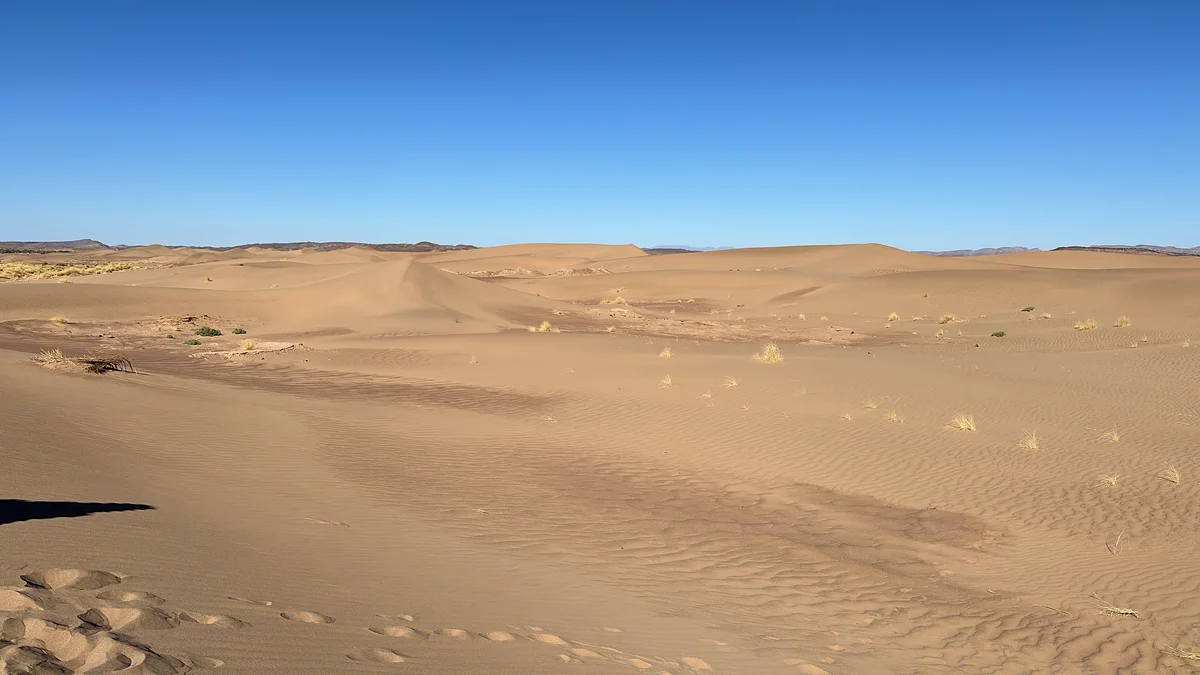
Chigaga's dunes are generally described as extensive rather than towering; its great spread, rather than the height of any single dune, is what stands out. Because there is no paved access and supplies must be hauled in by 4WD, there are fewer camps and far fewer visitors. The trade-off is comfort: Chebbi tends to offer more polished, easier-to-reach lodgings, while Chigaga rewards those who want wildness and solitude over convenience.
Getting there: 4WD or camel
There is no paved road to Erg Chigaga, so every visit involves either an off-road drive or a multi-day trek. The most common approach is a 4WD transfer from M'Hamid, typically a couple of hours across reg (stony desert), sandy tracks and dry wadis; the exact time depends on conditions. Some itineraries instead approach from the Foum Zguid side, passing the dry bed of Lake Iriki.
The slower, more immersive option is a camel trek of several days from M'Hamid, camping each night along the way. Some longer desert journeys begin much further north; see Marrakech to the desert for context on the wider route. Whichever you choose, a knowledgeable local guide or driver is essential, as the route is unmarked.
The landscape and the route
The journey to Chigaga is part of the experience. Rather than a single road, the way crosses a shifting mix of terrain: flat reg studded with dark stones, sandy stretches, and the channels of seasonal rivers that are dry for most of the year.
One of the better-known features along the broader route is Lake Iriki, a vast former lakebed that is usually dry; crossing its pale, cracked expanse is a striking contrast to the golden dunes. The dune field itself rises from the surrounding plain as a long sweep of soft sand, sculpted into ridges and bowls by the wind. The Drâa Valley and its palm groves form the green threshold you leave behind on the way south.
The experience: camps, silence and stars
Most visitors stay at a desert camp among or beside the dunes. Options range from simple nomad-style tents to more comfortable setups, though even the better camps here tend to be plainer than those at Erg Chebbi because everything must be carried in. See desert camping in Morocco for what to expect from a night under canvas.
The defining qualities of Chigaga are its silence and its sky. With no nearby town and minimal light pollution, nights are exceptionally dark, and on a clear evening the Milky Way is often easily visible. Days can be spent walking the dunes, watching the changing light at dawn and dusk, or sharing tea with the nomadic and Berber families who still move through this part of the desert. The remoteness is the point.
Practical considerations
Chigaga has essentially no permanent facilities beyond the camps themselves, so plan accordingly:
- Go with a guide or driver. The off-road route is unmarked and conditions vary; independent self-driving is not advisable without serious desert experience.
- Carry your own supplies. Bring ample water, snacks, sun protection, a hat and a head covering against blowing sand. There are no shops near the dunes.
- Pack for big temperature swings. Desert nights can be cold even when days are warm, so bring warm layers as well as light clothing.
- Manage expectations on connectivity. Mobile signal and power are limited or absent at many camps.
Booking a transfer or trek through a reputable operator in M'Hamid or Zagora is the usual way to arrange a visit.
Best time to visit
The most comfortable window is roughly October to April, when daytime temperatures are pleasant and nights are cool. Spring and autumn are widely considered the sweet spots, balancing mild days with manageable nights.
High summer (around June to August) brings extreme heat to this part of the Sahara, and many camps and services scale back or close; it is best avoided for anything but the shortest visit. Winter days are pleasant but nights can be genuinely cold, so pack warm layers. For a fuller seasonal breakdown across the region, see our guide to the best time to visit the Sahara.