Erfoud sits at the heart of the Tafilalet, the great date-palm oasis of Morocco's southeast, and for most travelers it is the last proper town before the sand begins. Roughly 50 km northwest of the erg at Merzouga and only about 20 km north of Rissani, it works as a hub: a place to refuel, change money, stock up, and arrange the final leg toward the Erg Chebbi dunes.
The town itself is unhurried and low-built, its character shaped by three things — the dates that ripen in its groves, the marine fossils quarried from the surrounding desert, and its role as a crossroads on the ancient caravan country around lost Sijilmassa. Erfoud rewards a short stop more than a long stay, but understanding it helps the whole desert route make sense.
Key facts
- Region
- Tafilalet, in the Drâa-Tafilalet region of southeastern Morocco
- Getting there
- On the main desert road via Errachidia; CTM and Supratours serve the area, with shared taxis for local hops
- Known for
- Gateway to the Erg Chebbi dunes, date palms and the autumn date festival, and fossil-rich "Erfoud marble"
- Best season
- Autumn and spring (roughly October–November, March–April); summer is very hot
- Nearby
- Rissani and ancient Sijilmassa (~20 km south); Merzouga and Erg Chebbi (~50 km southeast)
Gateway to Merzouga and the Erg Chebbi dunes
Erfoud's main role for visitors is as the staging town for the Erg Chebbi, the tall, photogenic sand sea above Merzouga. The dunes lie roughly 50 km to the southeast, and the paved road runs down through the desert and the village of Rissani before reaching the auberges strung along the western edge of the sand.
Many desert tours pause in Erfoud to organise the practical side of a dune trip: drivers, 4x4 transfers, supplies, fuel and cash before the smaller villages where services thin out. It is a logical overnight if you arrive late from the north and prefer to reach the dunes fresh the next morning, though plenty of travelers push straight on to sleep nearer the sand.
If you are routing the classic Marrakech to Merzouga journey, Erfoud is one of the last waypoints before the desert, and a useful reference point for orienting yourself in the wider Sahara tour circuit.
Dates and the autumn date festival
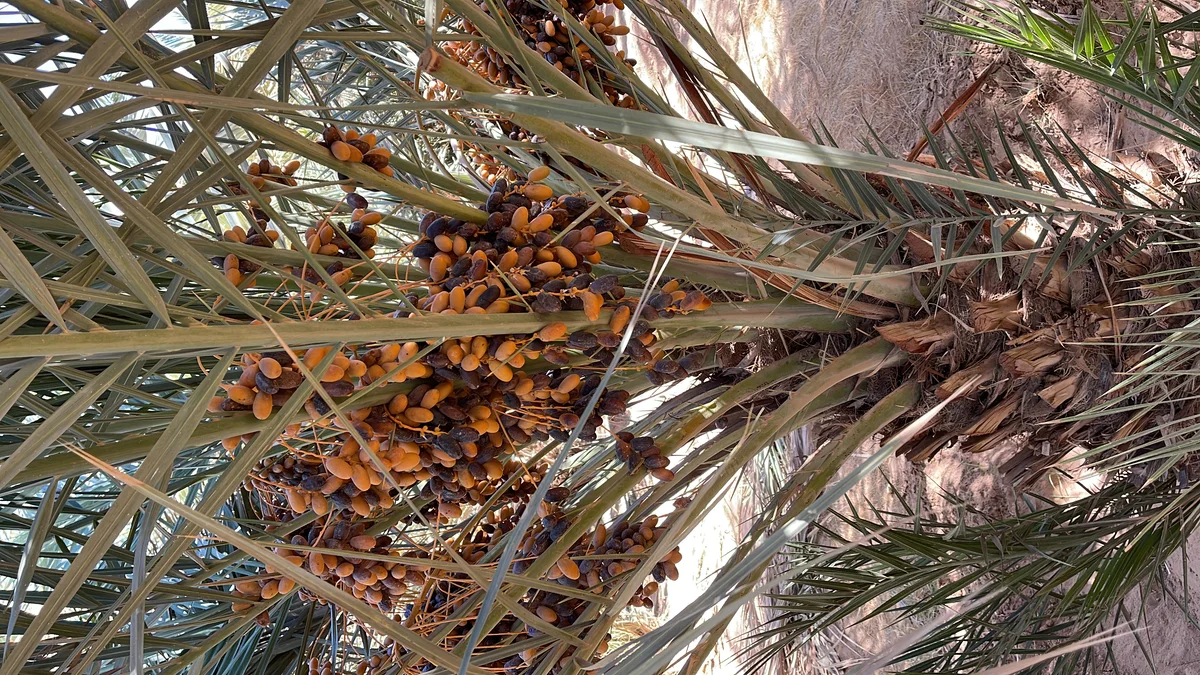
The Tafilalet is one of Morocco's most important date-growing regions, and Erfoud is often described as its date capital. The surrounding palm groves, fed by the Ziz and Rheris drainage, produce a range of varieties, and the autumn harvest is the agricultural high point of the local year.
Erfoud is well known for its annual date festival, traditionally held around October to coincide with the harvest. It is a celebration of the crop and of regional culture, typically featuring music, dancing, markets and displays of the season's dates. Dates from the Tafilalet remain central to local livelihoods and cuisine, and you will find them sold loose in the souk and offered with mint tea almost everywhere.
If you are interested in the wider oasis ecology and the palms themselves, the broader story of the region's groves is covered in desert trees and the long green ribbon of the Drâa Valley to the west.
Fossils and "Erfoud marble"
Erfoud is genuinely famous for fossils, and this is one of the most distinctive things to see here. The desert around the town was once an ancient seabed, and the rock is rich in marine fossils dating back hundreds of millions of years — most notably orthoceras (straight-shelled relatives of the nautilus), goniatites and trilobites.
Local workshops cut and polish dark limestone slabs packed with these fossils, producing the lustrous black stone sold as Erfoud marble. Polishing reveals the cross-sections of ancient shells as pale spirals and cones against the dark background, and the material is worked into tables, sinks, basins, platters and decorative pieces.
Visiting a fossil and marble workshop is a worthwhile stop: you can watch the cutting and polishing, see raw specimens and finished objects, and learn how the pieces are quarried from the surrounding hills. If you buy, expect to bargain, and bear in mind that genuine fossil quality varies widely between specimens.
Rissani and ancient Sijilmassa
Just south of Erfoud lies Rissani, roughly 20 km away, and with it one of the most important historical sites in the Moroccan Sahara. Rissani stands near the ruins of Sijilmassa, a medieval caravan city that flourished for centuries as a northern terminus of the trans-Saharan trade.
From around the 8th century onward, Sijilmassa grew wealthy by controlling caravan routes that carried gold, salt and other goods across the desert between the Sahel and the markets of the north. The city eventually declined and fell into ruin, but its legacy endures: the Tafilalet is the ancestral homeland of Morocco's ruling Alaouite dynasty, and Rissani remains a busy market town built among the remains of old ksour.
For travelers based in Erfoud, Rissani makes an easy half-day trip, especially on its lively souk days, and it pairs naturally with a continuation toward the dunes.
Desert and oasis landscape
Erfoud sits in a transitional landscape where the last oasis greenery gives way to open desert. The town's palm groves and irrigated gardens form a sharp line against the surrounding hamada — flat, stony plateau — and the sandy country that builds toward the dunes farther south.
The setting is classic pre-Saharan Morocco: wide skies, dark fossil-bearing hills, dry riverbeds that flood briefly after rain, and the long line of palms marking water beneath the surface. Beyond the immediate oasis, the terrain stretches toward the deep desert, and the contrast between cultivated green and bare rock is one of the defining sights of the Tafilalet.
From here the wider southeast opens up. The gorges of Todra and Dadès lie to the northwest along the road toward Tinghir, while the quieter desert town of Alnif — another fossil and trilobite center — sits off to the west on the route across the Anti-Atlas fringe.
Climate and when to visit
Erfoud has a hot desert climate, and the season makes a real difference to how comfortable a visit feels. Summer (roughly June to August) brings intense heat, with very high midday temperatures that can make sightseeing and dune trips uncomfortable in the middle of the day.
The most pleasant conditions are generally in autumn and spring — broadly October to November and March to April — when days are warm rather than scorching and nights are cooler. This window also overlaps with the date harvest and festival period in October, which adds to autumn's appeal.
Winter days are usually mild and sunny, but desert nights can be genuinely cold, so warm layers are essential if you are sleeping out near the dunes. For a fuller breakdown of conditions and what to pack across the year, see our guide to the best time to visit the Sahara.
Practical orientation for travelers
Erfoud functions well as a service town and route marker. It has the basics travelers need before the desert — fuel, shops, banks and cash machines, simple restaurants and a range of accommodation — which is why it features on so many desert itineraries even when the actual overnight is on the dunes.
National coach operators such as CTM and Supratours connect the broader region, typically running toward the desert via Errachidia, with onward shared taxis covering shorter local hops to Rissani and on toward Merzouga. Self-drivers will find Erfoud a natural fuel-and-supply stop before pushing south to the dunes.
A common pattern is to treat Erfoud as a pause rather than a destination: arrive, sort out supplies and any fossil-workshop visit, then continue to Rissani and the Merzouga dunes for a desert night. If you plan to camp in the sand, our overviews of desert camping and the camel trekking guide cover what to expect.