For many visitors, the strongest memory of the Sahara is not the dunes at sunset but the sky a few hours later: thousands of stars, the Milky Way arching overhead, and shooting stars streaking across the dark.
The Moroccan desert is a superb place for this. The air is dry, clouds are rare for much of the year, and away from towns there is almost no artificial light. But the experience varies hugely with where you stay, when you go, and especially the phase of the moon. This guide explains how to plan for the best possible sky.
Key facts
- Best moon phase
- Within a few days of the new moon; a full moon washes out all but the brightest stars.
- Darkest areas
- Erg Chigaga and remote camps far from town lights; quiet villages such as Oumjrane.
- Best season
- October to April for clear, comfortable nights; winter nights are cold.
- Milky Way core
- Best seen on spring to late-summer nights; bright winter constellations dominate in colder months.
- Meteor showers
- Perseids (mid-August), Geminids (mid-December), Quadrantids (early January).
- Bring
- Warm layers, a red-light headlamp and a star-chart app downloaded for offline use.
Why the Sahara sky is so dark
Three things combine in the desert. Dry air holds little moisture to scatter light, so stars look sharp and steady. Clear weather is common, especially from autumn to spring. And above all, there is very little artificial light: outside the towns, the nearest street lamps may be many kilometres away. On a moonless night in the dunes, the Milky Way can be bright enough to cast a faint glow on the sand.
Where to stargaze
- Erg Chigaga, beyond M'Hamid, is the remotest of Morocco's big dune seas and generally offers the darkest skies, with camps spread far apart and no town nearby.
- Erg Chebbi near Merzouga is far more accessible. Skies are still excellent, but the dunes are close to villages and some camps are large and well lit. Choose a camp in the deeper dunes and walk a little way from the lights.
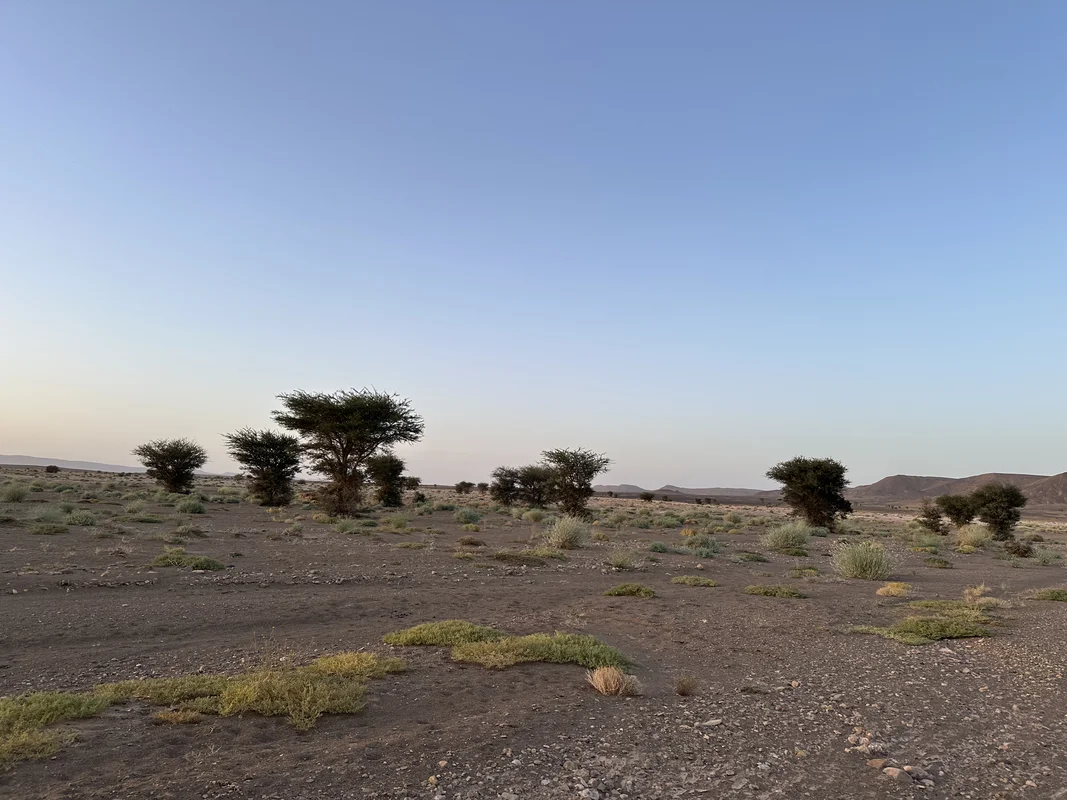
- The Anti-Atlas and remote oases, including the area around Oumjrane, are far from any city glow and can be outstanding, with the bonus of quiet, uncrowded nights.
Wherever you are, climbing a dune or walking a few hundred metres from camp makes a real difference. Take a headlamp, tell someone where you are going, and keep camp in sight.
Timing your trip: moon and seasons
The single biggest factor is the moon. Around the full moon, the desert is bathed in silvery light that is beautiful in its own way but hides most faint stars and the Milky Way. For the darkest skies, plan your desert night within a few days either side of the new moon, or choose nights when the moon rises late or sets early. Any moon phase calendar will show this; check it before you book.
Season matters too. From roughly October to April, nights are clear and comfortable to sit out in, though winter nights can drop close to freezing. The bright core of the Milky Way is best placed in the spring and summer months, especially later at night, while winter brings brilliant constellations such as Orion. Spring can bring wind and dust that hazes the sky; summer nights are warm, though daytime heat is intense. See our guide to the best time to visit the Sahara.
Meteor showers
Shooting stars are common on any dark desert night, but annual meteor showers bring many more. The most reliable are the Perseids, peaking around mid-August; the Geminids, peaking around mid-December; and the Quadrantids, peaking in early January. Rates are best after midnight and when the moon is down. The Geminids in particular coincide with cold but very clear desert nights.
How to see more: practical tips
- Let your eyes adapt. It takes 20 to 30 minutes for your night vision to fully develop, and one glance at a bright phone screen resets it.
- Use red light. A headlamp with a red mode preserves night vision; turn your phone to its darkest setting or night mode.
- Lie back. Spread a blanket on a dune and look up; it is far more comfortable than craning your neck.
- Dress warmly. Even after hot days, you will cool down quickly sitting still. See our desert packing list.
- Use an app, offline. Download a star-chart app and offline data before you go, as signal in the dunes is unreliable.
- Ask your hosts. Many desert guides know the sky well and can point out constellations and their local names.
Photographing the night sky
Modern phones with night modes can capture surprisingly good star images if braced on something steady. For serious astrophotography, bring a camera with manual controls, a sturdy tripod and a wide, fast lens. A typical starting point is an aperture as wide as your lens allows, ISO 1600–3200 and exposures of around 15–25 seconds (shorter for longer focal lengths, to avoid star trails), with focus set manually to infinity. Dunes, a tent or a camel silhouetted in the foreground give images scale. Protect your gear from sand and bring spare batteries, as cold drains them quickly.