Ouarzazate sits at the threshold where the High Atlas gives way to the stony pre-Sahara, and almost everyone heading into Morocco's southeast passes through it. It is less a single sight than a strategic crossroads, the place where the roads to the Drâa Valley, the Dadès and Todra gorges, and the deep desert all converge.
Often called the gateway to the desert, the town earns the title through geography. Coming from Marrakech over the Tizi n'Tichka pass, this is where the green mountain valleys end and the wide ochre plateaus begin. Ouarzazate is also Morocco's film capital, home to studios that have stood in for ancient Rome, Egypt, and biblical Jerusalem. Most travellers use it as a comfortable base, spending a night to break the journey, restock, and organise onward trips toward the dunes.
Key facts
- Region
- Drâa-Tafilalet, in Morocco's southeast
- Altitude
- High desert plateau, around 1,160 m above sea level
- From Marrakech
- Approximately 200 km over the Tizi n'Tichka pass (about 2,260 m)
- To Aït Benhaddou
- Roughly 30 km on the Marrakech road
- Known for
- Film studios (Ouallywood), the Taourirt Kasbah, and as the gateway to the desert
- Nearby landmarks
- El Mansour Eddahbi reservoir and the large Noor solar complex
The Gateway to the Desert and Crossroads of the South
Ouarzazate's role is best understood as a junction. From here, one road runs south down the Drâa Valley toward Zagora and the dunes at Erg Chigaga, while another heads east past the Dadès and Todra gorges toward Errachidia, Erfoud, and the great dunes of Merzouga.
This makes the town a natural staging post. Travellers commonly arrive in the afternoon from Marrakech, sleep, and continue the next morning in either direction. It is a practical place to draw cash, fill the tank, and pick up supplies before the longer desert stretches. Many Sahara desert tours are built around an overnight here, precisely because of its central position in the deep south.
Ouallywood: Atlas Studios and Morocco's Film Industry
Ouarzazate is famous as a filmmaking centre, nicknamed Ouallywood. Its dry light, dramatic landscapes, and ready-built sets have drawn international productions for decades, served chiefly by Atlas Studios and CLA Studios on the edge of town.
Well-documented films shot in and around the area include Lawrence of Arabia, The Last Temptation of Christ, The Mummy, Gladiator, and Kingdom of Heaven, while parts of the television series Game of Thrones were also filmed locally. Atlas Studios can usually be visited on guided tours that walk you through standing sets from past productions, from Egyptian temples to Tibetan and Roman backdrops. It is a popular half-day stop and pairs naturally with the kasbahs nearby.
The Taourirt Kasbah
The town's signature monument is the Taourirt Kasbah, a sprawling earthen fortress at the eastern end of Ouarzazate. Built from rammed earth and adobe, it is a warren of towers, courtyards, and decorated reception rooms that once belonged to the powerful Glaoui family, who dominated southern Morocco in the early twentieth century.
Today you can wander parts of the complex and the surrounding old quarter, getting a close look at traditional pisé construction and carved cedar ceilings. Its position right beside the main road, opposite the cinema museum, makes it an easy stop. While it is more modest than the dramatic hillside village at Aït Benhaddou, the Taourirt Kasbah gives a strong sense of the architecture that defines this whole region.
Aït Benhaddou and Nearby Sights
The single most celebrated sight near Ouarzazate is Aït Benhaddou, a fortified village of stacked earthen houses rising above the Ounila River, roughly 30 km away on the Marrakech road. A UNESCO World Heritage Site, it is one of the most photographed places in Morocco and has appeared in many of the same films associated with the local studios.
Most visitors treat Aït Benhaddou and Ouarzazate as a pair, seeing the ksar on the way in or out, then basing themselves in town. Beyond it, the surrounding country is dotted with smaller kasbahs and ksour, the fortified mud-brick settlements that give the pre-Saharan south its distinctive look. It rewards slow travel, with worthwhile stops scattered along the roads radiating out from the town.
Crossing the Tizi n'Tichka from Marrakech
The classic approach is the drive from Marrakech, about 200 km over the Tizi n'Tichka pass, the high crossing of the High Atlas that tops out at roughly 2,260 metres. It is one of Morocco's great scenic roads, winding up through Berber villages and walnut groves before cresting the mountains and descending toward the desert plateaus.
Allow a generous half-day with photo stops, as the route is long and twisting rather than fast. In winter, snow can fall on the pass and occasionally close it, so check conditions before setting out between November and March. For those without a car, CTM and Supratours coaches run between Marrakech and Ouarzazate, and the town is a standard first stop on the Marrakech to Merzouga overland route.
Landscape, Reservoir, and Solar Complex
Ouarzazate stands on a high, dry plateau ringed by mountains, with the El Mansour Eddahbi reservoir just east of town. The dam stores water from the Drâa basin and supplies the city and nearby farmland, its blue expanse a striking contrast to the surrounding ochre desert.
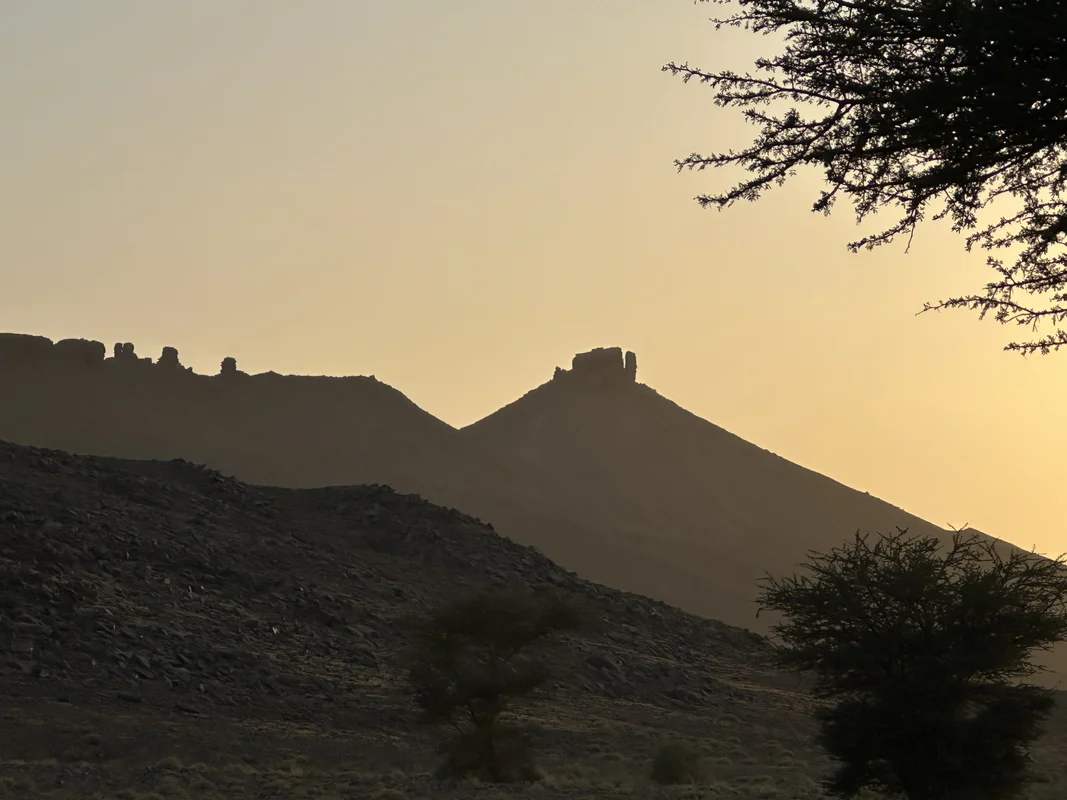
The area is also known for the large Noor solar complex, one of the world's biggest concentrated-solar installations, spread across the desert a short way outside town. Together the reservoir and the solar fields have become part of Ouarzazate's modern identity, a reminder that the region's intense sun and open space are resources as well as scenery. The wider landscape is classic pre-Sahara: flat-topped hills, dry riverbeds, and palm-fringed valleys.
Climate and Using Ouarzazate as a Hub
The climate is hot and dry, semi-arid in character, with very hot summers, cool winter nights, and low rainfall year-round. Spring and autumn are the most comfortable seasons for sightseeing and for onward desert travel; see our notes on the best time to visit the Sahara for timing the dunes specifically.
As a hub, Ouarzazate works well. It has a good spread of accommodation, restaurants, fuel, and tour operators, plus an airport with seasonal connections. Many people spend one night here and use it to organise a longer loop, heading south to the Drâa or east toward the gorges and dunes. If your trip centres on the deep desert, treat Ouarzazate as the practical launch point rather than the destination itself.